

Ramesh finished that modular kitchen in record time. Long shifts, full focus, and a homeowner who shared his number on the building WhatsApp group. Six months later she called back. The cabinet hinge near the sink had pulled clean away from the board. He knew before he even visited. The screws had gone in too easily. Too fast. At the time it felt like efficiency. Standing there looking at a stripped hole behind a hinge plate, he understood what it actually was.
The wrong screw for the material. And it had cost him something no job gives back quickly. His reputation.
Modular kitchen cabinets in India are almost universally built from one of three materials. Pre-laminated particleboard, MDF or HDF. Occasionally plywood for the frame. Rarely solid wood anymore.
Each of these behaves completely differently from the solid timber that older carpenters learned their craft on. And that difference is exactly where most cabinet screw failures begin.
Solid wood has grain. It compresses around a screw thread and grips it from all sides. Pull that screw and the wood fibres fight back. That resistance is what holds a hinge plate through years of daily use.
Particleboard and MDF have no grain. They are compressed wood particles held together with resin. A screw going into MDF is not gripping fibres. It is displacing particles. If the thread is too coarse, it pushes those particles aside and creates a loose channel instead of a tight one. If the screw is too thin, it does not displace enough material to grip. If it is driven too fast, the friction heat softens the resin around the thread and the holding power drops before the screw is even fully seated.
This is why a screw that works perfectly in a teak door frame will fail silently inside a particleboard cabinet. The material will not warn you. The screw will feel tight on the day. Six months later, Ramesh’s phone rings.
The screws for kitchen cabinets that hold longest are not the most expensive ones. They are the correctly matched ones. Here is what each cabinet material needs:
Particleboard and chipboard:
A screw with a coarse Hi-Lo thread. The alternating high and low thread ridges grip the compressed particles without over-displacing them. The thread needs to be sharp enough to cut cleanly rather than pushing material sideways. A coarse standard wood screw in particleboard creates an oversized channel. It feels tight going in and works loose under load.
MDF:
Similar to particleboard but denser. The same Hi-Lo coarse thread works well in the face. The edge of MDF is a different problem entirely. Screwing into MDF edge is one of the most unreliable joints in cabinet making. The compressed fibres at the edge have almost no lateral grip. If your cabinet design requires edge fixings, use a pocket hole or a confirmation screw with a barrel nut. A standard screw in MDF edge will always eventually fail.
Plywood:
More forgiving. A standard wood screw works here. The cross-grain layers give the thread something real to grip. Still use a pilot hole near edges.
Hardwood frame with board panels:
Use the appropriate screw for whichever material the screw is entering. Hardwood to hardwood is a wood screw with a pilot hole. Board to hardwood is a chipboard screw.
Most hardware shops in India sell what they call ‘furniture screws’. Ask for something more specific and the shopkeeper will hand you whatever moves fastest off his shelf. On many sites, carpenters reach for drywall screws because they are cheap, available in bulk and go in fast.
This is exactly the mistake that empties hinges and sags cabinet doors.
Chipboard screws for cabinets are designed around one specific engineering principle. The thread is deep, sharp and widely spaced. That geometry does two things. It cuts cleanly into the compressed wood particles rather than pushing them. And it creates maximum surface contact between the thread face and the material. More contact means more resistance when the joint is pulled.
A drywall screw has a fine thread designed for gypsum board and metal channel. Drive it into particleboard and the fine thread tears through the particles rather than gripping them. It will feel solid for weeks. Under the repeated stress of a cabinet door opening and closing fifty times a day, the joint slowly loosens. By month six it has given up entirely.
The chipboard screw is not a premium product. It is a correctly engineered one. The difference in price between a chipboard screw and a drywall screw is a few rupees per hundred pieces. The difference in what happens to your reputation is not measurable.
LP Screw’s SS Chipboard range is built with a deep sharp thread that cuts cleanly through particleboard and MDF without cracking or splitting the board. Each screw is available in both stainless steel and mild steel depending on whether the installation is in a dry interior or a kitchen environment with moisture exposure near the sink and cooking area.
Recommended Screws for Kitchen Cabinet Installation
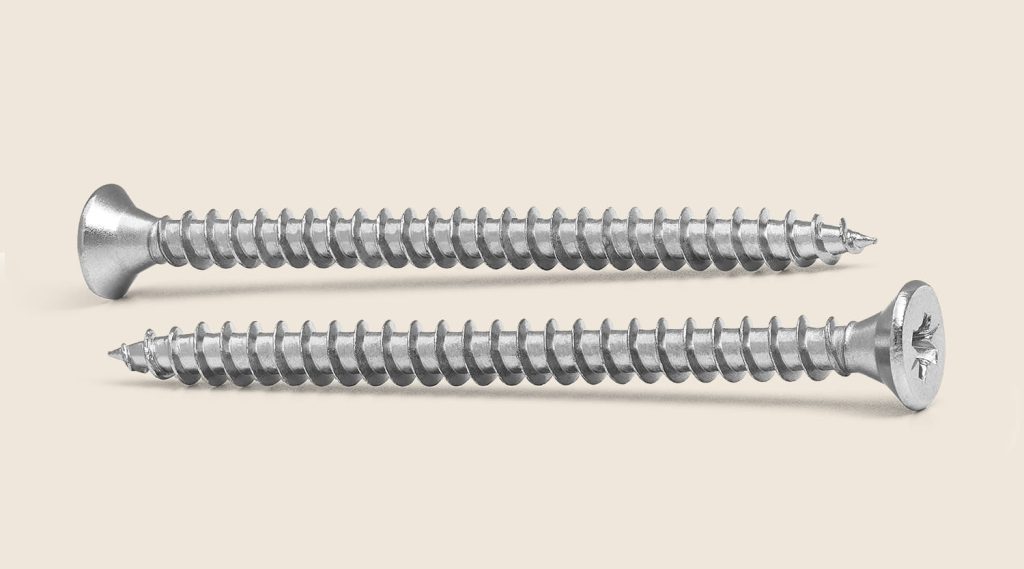
Deep sharp Hi-Lo thread. Cuts cleanly into particleboard and MDF without splitting. Available in SS for kitchen environments where steam and moisture are a daily reality.
Available in: M3.0×12mm to M5.0×100mm
Mild Steel option available for dry interior cabinetry.
A self thread screw earns its place in one specific part of cabinet installation. Anywhere metal meets board.
Hinge plates on modern modular cabinets are steel. Drawer channel brackets are steel. Handle backplates are sometimes aluminium. These metal components need to be fixed either to the board or to a metal frame behind the board.
A standard chipboard screw is not designed to tap into metal. A self thread screw is. It cuts its own thread into the metal component as it drives through, creating a tight metal-to-metal or metal-to-board connection without a pre-tapped hole.
On a full modular kitchen build, a carpenter will use chipboard screws for cabinet carcass joints and board connections, and self thread screws for hinge plates, channel brackets and any metal-to-metal fixing points. Using one where the other belongs is where joints fail quietly and call back loudly.
The right screw in the wrong position fails just as surely as the wrong screw.
Edge distance matters:
Drive a screw closer than 10mm from the edge of a particleboard panel and the board will crack. The compressed particles at the edge have no room to accommodate the displaced material. Keep a minimum of 12mm from any edge. 15mm is safer.
Pilot holes in MDF face:
MDF is dense enough that a pilot hole reduces the driving friction significantly. Less friction means less heat. Less heat means the resin around the thread stays hard and the joint stays tight. A 3mm pilot hole for a 4mm chipboard screw in MDF face takes five seconds and adds years to the joint.
Screw depth:
The screw should penetrate the receiving material by at least 25mm for a load-bearing joint like a hinge plate. A 16mm screw into 18mm MDF is barely gripping anything. Use 30mm minimum for hinge fixings.
Torque control:
Drive chipboard screws at medium clutch setting. Full torque in a power drill will overdrive the head into MDF and strip the hole before the screw is seated. The head should sit flush. Not below the surface. Flush.
1. What screws to use for kitchen cabinet installation?
Chipboard screws are the correct choice for screws for kitchen cabinets built from particleboard, MDF or HDF. Their deep Hi-Lo thread cuts cleanly into compressed board material and creates a tight joint that holds under the daily stress of opening and closing. Use stainless steel chipboard screws near sinks and cooking areas where moisture is present.
2. Can I use wood screws instead of chipboard screws for cabinets?
Not for particleboard or MDF. Wood screws have a thread geometry designed for solid timber grain. In particleboard they push material sideways instead of gripping it, creating a loose channel that works free under load. Chipboard screws for cabinets have a specific Hi-Lo thread engineered for compressed board materials. The difference shows up six months after installation.
3. What size screw for 18mm MDF cabinet?
For face fixings in 18mm MDF, a 4mm × 30mm chipboard screw works well. It gives 12mm of thread engagement in the receiving board after passing through the first panel. For hinge plate fixings use 4mm × 35mm minimum. Always drill a 3mm pilot hole in MDF face to reduce heat friction and protect the joint’s long-term holding power.


