
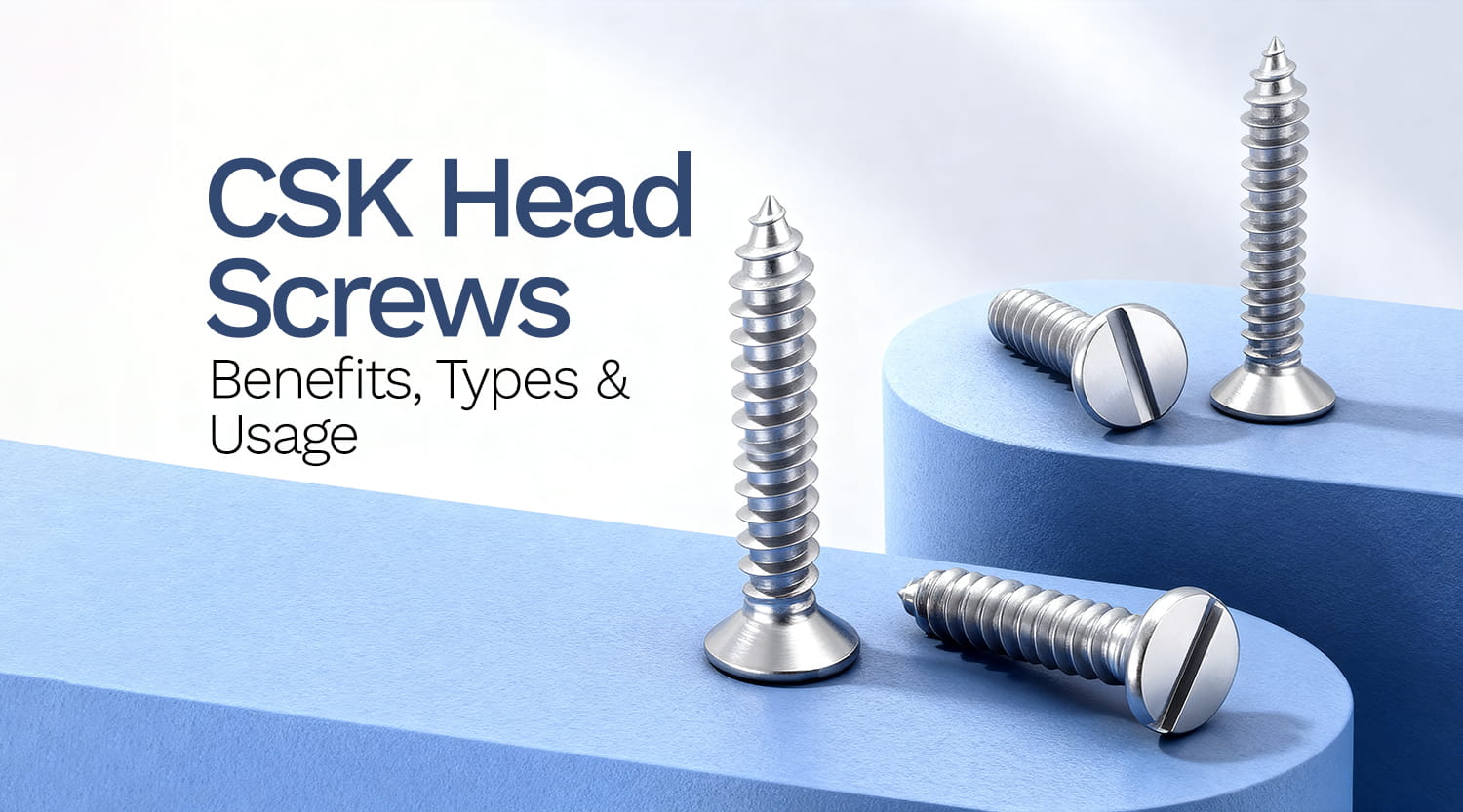
When you run your palm across a well-finished wooden shelf and you feel nothing. There is no bump or a snag and not even a metal edge that catches your skin. It means that the surface was done right. Somewhere under that smooth finish, a screw is holding everything together and yet you just cannot feel it nor even see it.That is exactly what a CSK head screw is built for. It drives to exactly the right depth. While most people think a screw is just a screw, but in reality the head shape changes everything. A pan head screw sits above the surface, while a CSK head Screws disappears into it.
CSK stands for countersunk. The underside of the head is tapered at an 82-degree angle. When you drive it into a countersunk hole, that taper pulls the head down flush with the surface. Sometimes below it. Never above it.
That geometry is the whole point.
A pan head screw clamps material by pressing down from above. A CSK head screw pulls itself into the surface as it tightens. The taper creates a wedging action that actually increases the clamping force as you drive it in. The deeper it goes, the tighter the fit.
This is why CSK head screws are the default choice for any job where the surface finish matters. For example : Door frames, cabinet faces, shelf brackets, furniture joints and basically anywhere a protruding head would catch a hand, snag a cloth, simply look unfinished.
One thing to get right before driving: the countersink angle of the hole must match the screw. Most CSK screws are 82 degrees. Some are 90 degrees. Drive an 82-degree screw into a 90-degree countersink and the head will never sit flush. It will rock slightly and leave a small gap around the edge. That gap collects dust, moisture and eventually becomes a problem.
This is where most people at the hardware shop go wrong. Both look similar. Both have a countersunk head. The thread is completely different and that difference decides whether the joint holds or fails.
The CSK wood screw has a tapered shank and a coarse thread designed to grip timber fibres. The thread runs partway up the shank, not the full length. That unthreaded shank section near the head pulls the two pieces of wood tight together as the screw seats. It is the right choice for timber, plywood and hardwood frames.
The CSK self thread screw has a finer, sharper thread that runs the full length of the shank. It is designed to cut its own thread into the material as it drives. You can use this for MDF, particleboard, chipboard and metal-to-board connections like hinge plates and channel brackets.
The wood screw vs self thread screw decision comes down to one question. What material is the screw going into? For solid timber and plywood, wood screw gets the job done. For a compressed board and metal components, a self thread screw can be a better choice.
When you get these things wrong and the joint may feel tight on the day, but will loosen up within a few days. Six months later it will simply fail. Hence, choosing a right screw is essential.
CSK head screws are the right call in these situations:
Pan head screws are actually better in these situations:
Knowing when not to use a CSK screw is as useful as knowing when to use one. A good carpenter does not reach for the same head type every time.
The screw is only half the job. The countersink in the material is the other half.
When you are working with hardwood like teak or sheesham, a pilot hole is not optional. Without it the screw generates too much friction, the head strips before it seats. Thus, you lose the flush finish before you get there. Pilot hole diameter should be 70 to 80 percent of the screw shank diameter.
You can use a countersink bit at the same angle as your screw head, 82 degrees for most CSK head screws. The countersink should be deep enough that the screw head sits exactly level with the surface. Test with one screw before driving the rest.
Full torque on a power drill will overdrive the head below the surface and collapse the countersink hole in soft materials like MDF. Medium clutch setting. Stop the moment the head is flush.
This is the only check that matters. If you feel the head, it is not flush. Back it out slightly and re-drive at lower torque. If you feel a small depression, the head has gone too deep. That joint is weaker than it should be.
Two millimetres is the difference between a professional finish and one that needs filling. Take the extra thirty seconds and you will not have a need to take it for the second time.
Single slot manual drive. Tapered shank with coarse thread for clean grip in timber and plywood. Sits flush every time when the countersink angle matches.
Available in: Gauge 4 to Gauge 16 | 12mm to 150mm length
Stainless Steel. Built for finishing work that needs to last.
[ View Product → lpscrew.com/products/manual-screws/csk-wood ]
There is a reason experienced carpenters are particular about which screw goes where. They have seen work come back. A protruding head on a cabinet face that the client notices every morning. A hinge plate that sits slightly proud because the screw was not driven flush. Small things. But the client remembers them.
CSK screws from a reliable CSK head screws manufacturer in India are not expensive. The difference between a good packet and a cheap one is a few rupees. The difference in finish quality is visible every time someone runs their hand across the surface. The wood screw vs self thread screw decision takes five seconds to make correctly. The countersink depth takes thirty seconds to get right. That total of thirty-five seconds per fixing is what separates work that looks handmade from work that looks finished.
A perfectly flush finish starts with a perfectly made screw. As a trusted CSK head screws manufacturer in India, LP Screw builds every screw to that standard. Explore the complete CSK range at lpscrew.com. For industrial or bulk orders, the team is just a call away.
FAQ
1. What is a CSK head screw used for?
Anywhere the screw head needs to disappear into the surface. Door hinges, cabinet faces, shelf brackets, furniture joints and flooring are the most common applications. If the finish matters, CSK head screws are the default choice.
2. Wood screw vs self thread screw: which CSK is right for my job?
Simple rule. Solid timber and plywood: CSK wood screw. MDF, particleboard and metal hinge plates: CSK self thread screw. The material decides, not the job.
3. How do I get a CSK screw perfectly flush with the surface?
Drill the pilot hole, countersink at 82 degrees, drive at medium torque and stop the moment the head is level. Run your finger across. No bump means flush. Three seconds to check. No excuses to skip it.


