
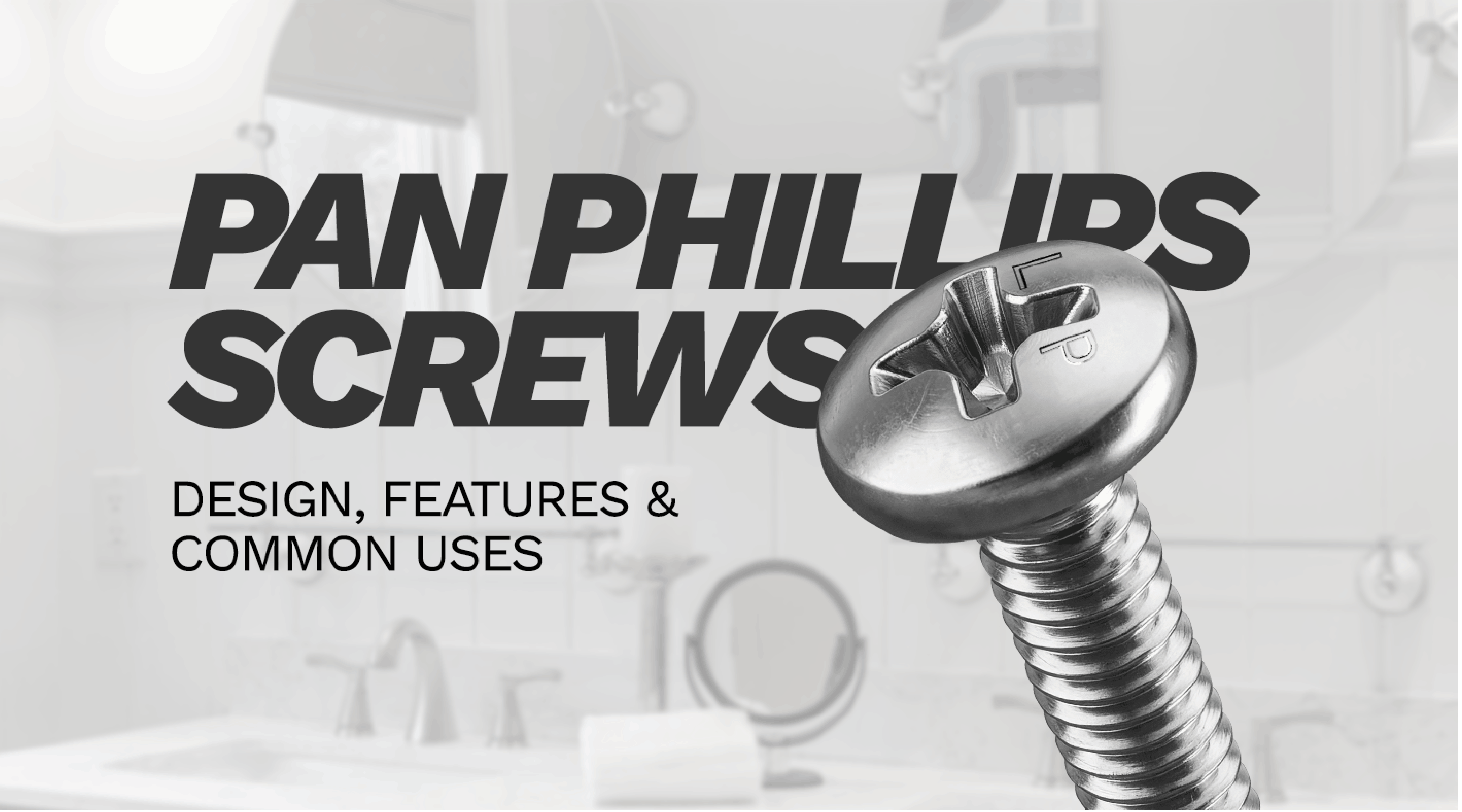
If you open the electrical panel in your factory and look at the license plate of your car or check the back of your washing machine, you will see the same fastener staring back at you. It has a round top, a flat bottom and a cross in the center. On most Indian sites, mechanics simply call it the ‘Star Head Screw’ or the ‘Round Head Screw’. But for professionals, it has a proper name. It is called the Pan Phillips Screw. It is one of the most common and most used screws in the world. Sadly, it is also the most incorrectly used screw as well. Beginners often confuse it with Truss heads or try to countersink it into wood, which is technically incorrect.
Today, we are going to break down the engineering behind Pan Phillips Screws, why they are the default choice for surface-mounted applications, and how to spot the difference between a high-quality fastener and a cheap market imitation.
Unlike a Countersunk (CSK) screw, which is designed to bury itself inside the material, a Pan Head is designed to sit on top of the material.
It has two distinct features:
1. The Phillips Drive: On the site, we often call this the ‘Star’ drive. It is the cross-shaped slot in the center. It is designed to be self-centering. Thus, when you push your drill machine or screwdriver, the bit naturally slides into the middle and locks in. This allows you to drive the screw straight without wobbling.
2. The Pan Head: The top has a gentle curve so there are no sharp edges to catch your hand. But the important part is underneath. It has a completely flat bottom. This flat surface acts like a washer. It presses down on the sheet metal or plastic, clamping it tight without cracking it.
When you combine these, you get a fastener that is safe, strong and easy to drive with power tools. This is why Pan Phillips Screws are a go to choice for consumer electronics to heavy industrial machinery.
Why not just use a countersunk screw everywhere? It looks cleaner, right? This is a common error on assembly lines.
A countersunk screw acts like a wedge. When you tighten it, the V-shape of the head pushes the material outward. If you use a CSK screw on a thin metal sheet or a plastic electrical cover, that wedge effect will crack the plastic or stretch the metal hole until the screw pulls right through.
This is where a Pan Head Screw works differently. Because it has a broad, flat underside, it doesn’t push outward; it pushes downward. This creates what engineers call ‘Clamping Force’.
The flat surface acts like a built-in washer. It distributes the pressure over a larger area which helps to grip the top sheet firmly, without damaging the hole. To fasten a plastic switchboard cover or a metal machine guard, the Pan Head is a correct choice.
Here is what defines a premium Pan Phillips Screw:
The Pan Head is distinct because of its height. It has deep vertical sides. This allows for a deeper driving recess. A cheap screw often has a ‘shallow pan’, meaning the cross slot is not punched deep enough. You apply torque, and the driver pops out. A quality screw has a high profile to accept the bit fully.
The cross shape wasn’t just drawn randomly. It was invented specifically for the automotive industry to be ‘self-centering’. When you push the driver into the slot, it naturally slides to the center. This is crucial for automated assembly lines where speed matters.
This is a detail for the experts. Where the flat underside of the head meets the shank (the threaded body), there should be a slight curve or fillet. If this corner is too sharp, the head can snap off under torque. If it is too round, the screw won’t sit flat. Achieving this balance is the mark of a top-tier Pan Phillips Screws manufacturer.
Because of their ability to clamp without splitting, these screws are the workhorses of the assembly world.
Open any switchboard or breaker box. The screws holding the faceplate are almost always Pan Phillips. Why? Because electrical boxes are often made of brittle plastic. A countersunk screw would crack the corner of the faceplate. The Pan Head clamps it gently but firmly.
From holding the dashboard trims to securing the license plate, Pan Phillips Screws are preferred because they have no sharp edges. If a driver’s knee bumps against the dashboard screw, the rounded ‘Pan’ top prevents injury or snagging.
For applications such as HVAC ducting or server racks, while joining two thin sheets of metal, countersinking the hole becomes a challenge as the metal is too thin. The Pan Head screw sits perfectly on the surface and provides the necessary hold.
Why is this the site standard? Here are the practical benefits:
Cam-Out means when the screwdriver slips out of the cross slot while tightening and damages the screw head.
Phillips drives come in specific sizes: PH1, PH2, and PH3.
In India, many helpers use a single worn-out screwdriver for everything. If you use a pointed PH1 driver on a PH2 screw, it will slip. It will strip the metal. To maximize the benefits of pan head screw joints, remember to match the driver bit to the screw size.
The market is flooded with ‘commercial grade’ fasteners made from worn-out dies. The result? A shallow, off-center cross that makes your drill bit wobble.
At LP Screw, as a dedicated Pan Phillips Screws manufacturer we treat the recess as the critical dimension. We ensure the Phillips screw slot is punched deep and dead center. This guarantees a lock-tight fit with your driver bit. No slips. No stripped heads. Just a straight, true drive every time.
The Pan Phillips Screw is an engineered clamping device designed to hold fragile or thin materials securely without damage. Whether you are building a control panel, fixing a machine guard or just tightening a loose handle at home, this is the fastener you trust when surface grip matters.
Don’t let a stripped head slow down your project. Choose the right size, use the right driver and always insist on precision manufacturing.
Q: Can I use a Pan Head screw in wood?
A: Yes, absolutely. It is excellent for attaching hardware like drawer slides or hinges to wood where you need a flat bearing surface. However, unlike a countersunk screw, the head will protrude (stick out), so ensure it doesn’t block anything.
Q: What is the difference between Pan Head and Round Head?
A: In the past, ‘Round Head’ screws were more domed (high crown). Modern ‘Pan Heads’ have a flatter top and broader profile. In today’s industry, the Pan Head has largely replaced the old Round Head design because it offers better grip for the screwdriver.
Q: Why does my screwdriver keep slipping out of the Phillips slot?
A: This is called ‘Cam-Out’. It usually happens for three reasons:
Q: Are LP Pan Screws available in Stainless Steel?
A: Yes. We offer Pan Phillips screws in high-grade Stainless Steel (304 and 316) for corrosion resistance, as well as hardened carbon steel for high-strength applications.


