
There are two packets of the same size screws. One costs sixty rupees per hundred. The other costs ninety-five. Both say stainless steel on the label. The shopkeeper says they are the same thing, just different brands. They are not the same thing.
One of them will hold an outdoor pergola through fifteen monsoons without a mark on it. The other will start showing rust streaks within two years and leave brown stains running down the timber it was supposed to protect. But standing at that counter, most people cannot tell which is which. They guess. They go with the price. Or they go with whatever the shopkeeper pushes that day.
This article will not teach you to read a chemistry report. It will teach you what your eyes and your hands can tell you in thirty seconds at the shop. That is a more useful skill.
‘Stainless steel’ on a packet means almost nothing by itself. It is like a restaurant putting ‘good food’ on its signboard. The claim costs nothing to make and nobody checks it.
The real question is not whether the screw is stainless. It is how much chromium is actually in the alloy and whether the manufacturing process preserved that protection through every stage of production. A screw can be made from decent raw material and still end up weak if the threading was done at too high a temperature, or if the surface was not properly passivated after machining.
You cannot see any of that from the outside. But poor manufacturing leaves signs. You just have to know what to look for.
Pick up one screw and hold it near the light. Here is what you are checking.
The surface finish:
A properly made stainless screw has a consistent, slightly muted silver finish across the entire surface. Not mirror-bright. Not dull grey. Somewhere in between, and consistent from head to tip. If you see patches of brighter and duller areas on the same screw, the surface treatment was uneven. That unevenness means the passive protective layer is uneven too.
The head geometry:
Look at the drive recess. On a good screw it is clean, sharp-edged and symmetrical. On a cheap one the recess is slightly off-centre, or the edges are already rounded before the screw has been driven once. A blurred recess is a manufacturing shortcut. The same shortcuts were taken in the alloy composition.
The thread:
Run your thumb lightly along the thread from tip to head. The ridges should feel sharp and consistent all the way up. If the thread feels uneven, almost chalky in texture, or if you feel burrs anywhere, the machining was poor. Poor thread machining means higher friction during driving, which means more heat, which means micro-damage to the very surface you are counting on for outdoor protection.
The point:
A good stainless screw has a clean, centred point. Not blunt, not bent slightly to one side. If the point is even a little off-axis, it will walk when you start driving it, especially in hardwood. And a screw that walks creates an oversized entry hole. Water finds that gap and sits there.
Visual checks catch a lot. Physical checks catch the rest.
Weight:
Hold a handful of screws loosely. They should feel dense and consistent, all roughly the same weight. Cheap alloys often have more filler and less chromium content. A lighter-than-expected screw is a warning.
The thread between your fingers:
Pinch the thread of one screw between your thumb and forefinger and press gently. You should feel clean, sharp biting. Not rough like sandpaper. Not so smooth it feels polished away. Sharp and consistent. That sharpness tells you the thread was cut properly and will grip your material cleanly rather than fighting its way in.
The head edges:
Press your thumbnail lightly against the edge of the screw head where it meets the shank. On a quality screw this edge is crisp. On a cheap one it is already slightly soft, almost rounded. That softness means the head will deform under torque before the screw is fully seated.
Every hardware shop has someone doing this. They touch a magnet to a screw. If it does not stick, they nod and accept it as genuine stainless. This test has real value but people misread the result.
Good stainless steel, Grade 304 or 316, is mostly non-magnetic. So a screw that does not attract the magnet at all is a reasonable sign. But here is what most people do not know: the factory process of cold-forming and thread-rolling can make even genuine 304 slightly magnetic. A very weak pull toward a magnet does not automatically mean the screw is fake.
What the magnet test actually catches is the worst offenders. A screw that snaps hard to a magnet, the way a mild steel screw does, is not stainless in any meaningful sense. It is plated carbon steel. It will rust through in one outdoor season. Use the magnet to eliminate the obvious fakes. Do not use it to certify quality.
A screw does not fail the way people expect. It does not wake up one day looking rusty. The lifespan of stainless steel screws in outdoor use ends slowly, invisibly, starting from where the screw head meets the surface.
Imagine a balcony railing in Chennai. The screw has been driven correctly into a hardwood post. The first monsoon comes and goes. The screw looks fine. The second year, a very thin brown line appears where the head meets the wood. The owner ignores it. By the fourth year, that thin line is a rust shadow that has crept under the head. The wood around it has started to soften. The screw itself is still technically in place but it is no longer clamping anything. The joint has quietly given up.
This is what poor grade stainless steel screws in outdoor use look like in a coastal Indian city. Not a dramatic failure, but a slow surrender to the climatic challenges.
A properly graded outdoor stainless steel screw in the same location would look almost identical to day one after four years. The difference is entirely in what you bought at the shop counter and whether you knew how to judge it.
LP Screw’s outdoor range is manufactured with a surface passivation process applied after thread rolling. That extra step rebuilds the protective layer that the machining process disturbs. Most commodity screws skip it. You can see the difference in the finish consistency when you hold one against a commodity screw in the same light.
| What to Check | Accept | Reject |
| Surface finish | Consistent muted silver, even across head and shank | Patchy bright and dull areas on the same screw |
| Drive recess | Clean, sharp, symmetrical | Off-centre, already rounded, rough edges |
| Thread feel | Sharp, consistent biting from tip to head | Burrs, uneven ridges, chalky texture |
| Point | Centred, clean taper | Slightly bent, blunt, rough tip |
| Magnet response | No pull or very faint pull | Snaps to magnet like carbon steel |
| Head edge at shank | Crisp, defined edge | Already soft or rounded before use |
| Weight in hand | Dense, consistent across a batch | Noticeably light for the size |
LP Screw Stainless Steel Carriage Bolt
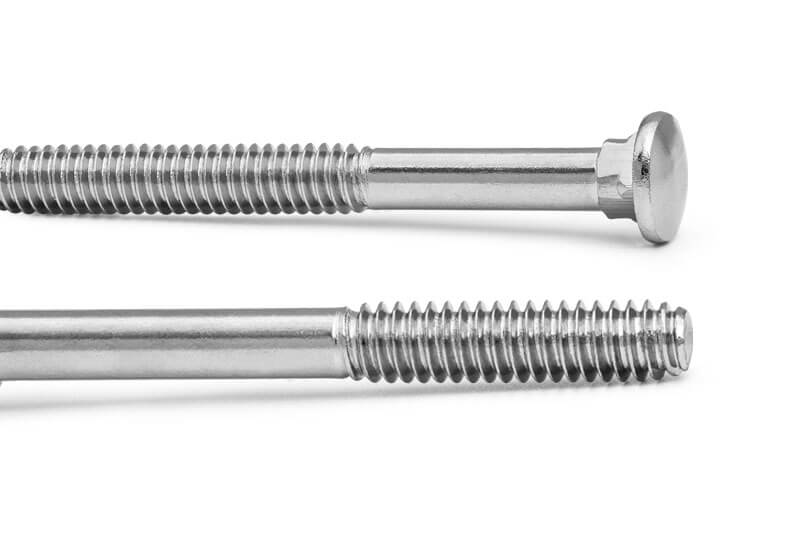
No drive recess. No water trap. No exposed head to corrode from outside in. The smooth dome head sits clean on the surface while the square neck locks into the timber below. Built in Stainless Steel only. Because LP Screw does not make this one in mild steel.
Available in: 6mm × 38mm to 125mm | 8mm × 100mm to 250mm
Comes with SS Hex Nut and SS Fat Washer.
The screw market in India has a specific problem. The same shop shelf will carry genuinely good stainless screws next to polished carbon steel screws that look identical. The only real protection is sourcing from a stainless steel screws manufacturer who grades and certifies their output.
LP Screw publishes the alloy composition for each product in their outdoor range. That is not common in the Indian market. Most commodity suppliers cannot tell you what is actually in the packet because they do not know themselves. The karigar who learns to judge by eye and by hand at the counter is protecting his own reputation. A joint that fails three years after his name was on the job is his problem, not the shopkeeper’s. That thirty-second check before buying is the cheapest insurance available.
The lifespan of stainless steel screws in outdoor use is not decided by the monsoon or by the sea air or even by how the screw was driven. It is decided at the shop counter, before a single screw touches wood.
Buy like you know the difference, because now you do.
1. How can I tell if a stainless steel screw is good quality before buying?
Check the surface finish for consistency, the drive recess for sharpness and symmetry, and the thread for clean even ridges from tip to head. Press a magnet to it: a hard snap means carbon steel, not stainless. Hold a handful and feel the weight. These checks take thirty seconds and catch most bad batches before they reach your work.
2. Does a magnet test work on stainless steel screws?
Partly. A screw that snaps hard to a magnet is almost certainly not genuine stainless and should be rejected. But good Grade 304 screws can show a faint magnetic pull due to cold-forming during manufacture. Use the magnet to eliminate obvious fakes. Do not rely on it alone to confirm quality in outdoor stainless steel screws.
3. What do outdoor stainless steel screws look like after years of use?
A properly graded stainless screw in outdoor use should look nearly identical to the day it was driven in, even after several years of monsoon exposure. If you see brown staining around the head or rust lines running down the timber below the joint, the screw was either low-grade, incorrectly installed, or both. The lifespan of stainless steel screws in outdoor use is largely decided by what was purchased, not by the weather.


