
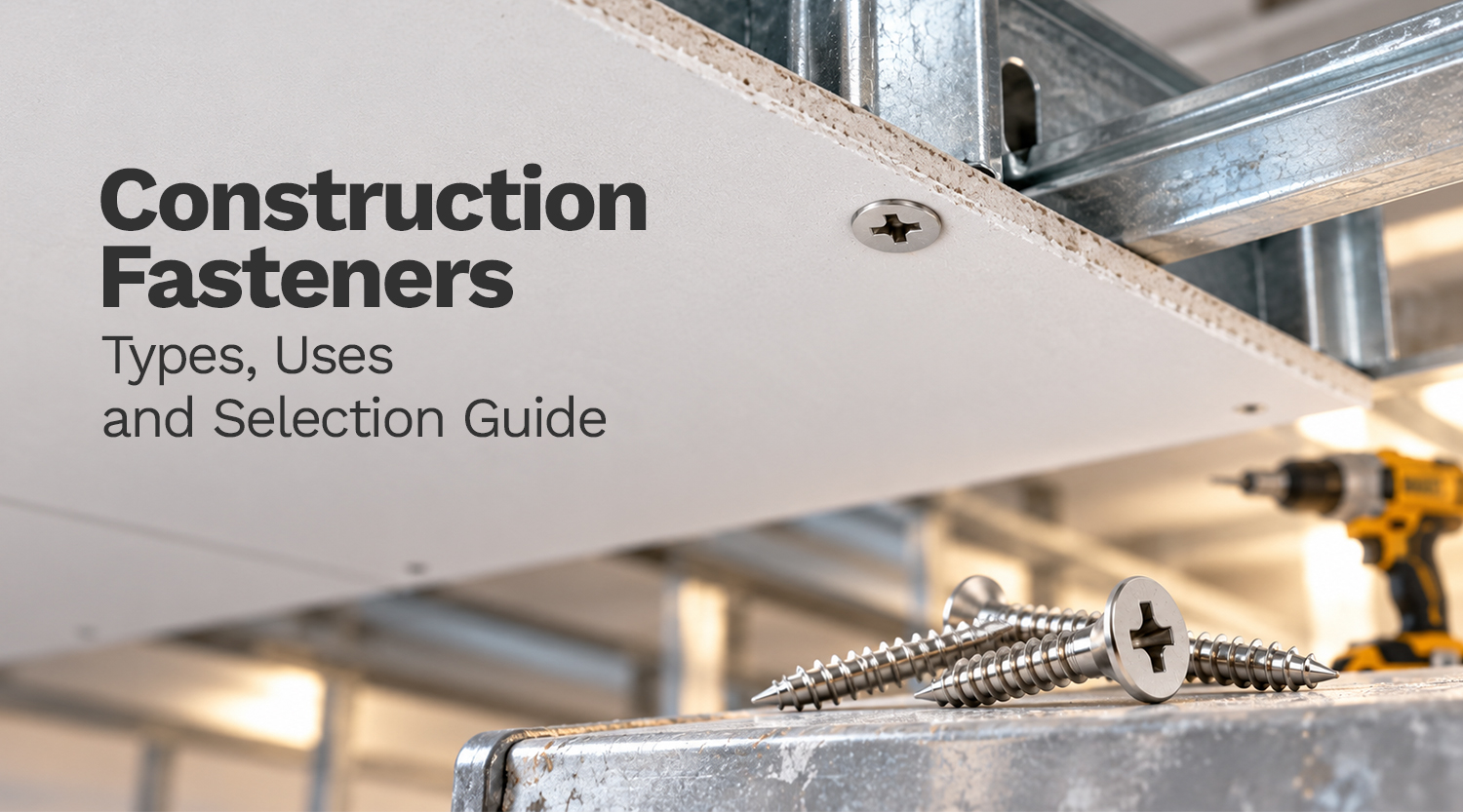
Most construction fasteners on an Indian site get picked by what mistriji already has in his bag. That works while the base material stays the same. On a single floor of a flat it can change from GI channel to 18mm MDF to teak before lunch.
A screw holds because its thread cuts into something and that something pushes back. Gypsum board pushes back very little. Its strength sits almost entirely in the paper facing, which is why a drywall screw carries a bugle head whose trumpet curve presses that paper down without cutting it, while the thread does its real holding in the GI channel behind the board.
Sheet steel and pipe have nothing soft to bite into. The screw has to make its own hole and then tap a thread into the wall of that hole, so the thickness it can get through depends entirely on the drill point at the tip.
Timber and MDF sit in between. Chipboard needs a deep, sharp thread that cuts through the board without cracking or splitting it, and a hardwood like teak needs a wood screw of the right gauge. Brick and RCC need a masonry anchor. We do not make those, so fixing into the wall itself needs a different source.
The table lists our site range.
| Fastener | Head and drive | Sizes | Where it goes |
| SS Drywall | Bugle head, Phillips | Gauge 6 (3.5mm) and 8 (4.5mm), 13mm to 75mm | Gypsum board to GI channel, frames and TV mounts on walls |
| SDS | Self drilling point, carbon steel | Drills 4mm to 4.5mm thick metal | Sheet metal, steel pipe, metal sub-frames |
| Carriage Bolt | Dome head, nut from below | 6mm (38mm to 125mm), 8mm (100mm to 250mm) | Decking, outdoor benches, structural wood joints |
| Machine Screw | CSK, slotted or Phillips | M2 to M10, BSW 1/8″ to 3/8″ | Metal parts with a nut or tapped hole |
| SS Chipboard | CSK, Phillips | M3.0 to M5.0, 12mm to 100mm | Modular kitchens, wardrobes, MDF carcasses |
| Wood Phillips | CSK, Phillips | Gauge 4 to 16, 12mm to 150mm | Timber to timber with a drill |
Most self drilling screws sold loose in the market get through 1.5mm to 2mm of metal and then stall, and a screw that stalls usually gets forced until the point burns out. Our SDS is carbon steel, and its drill point goes through 4mm to 4.5mm thick metal.
Decking on steel needs wings. On the winged SDS, small wings ream a clearance hole through the wood, then snap off the moment they hit the steel, so the thread only starts tapping once it is inside the metal and the plank stays down on the frame while the screw seats. When a plank lifts off the frame before the screw is fully home, it is called jacking.
LP SDS Screw
Carbon steel with a drill capacity of 4mm to 4.5mm thick metal. CR6+ coating at 6+ microns, with a 96 hour salt spray pass. The LP mark is on every screw head. Full details at lpscrew.com/products/.
A carriage bolt has a smooth dome head with no slot at all. The square neck under the dome bites into the wood as the nut is tightened from below, which locks the bolt against turning and leaves nothing sharp on a bench seat or a deck board. We make it in SS, in 6mm and 8mm diameters, with lengths running up to 250mm on the 8mm size.
A machine screw cannot hold alone. It needs a tapped hole or a nut behind it, and our SS hex nuts in BSW thread and SS fat washers come in the same 1/8″ to 3/8″ sizes, packed 1000 to a box.
Sites get this wrong both ways. Some contractors put stainless steel into dry bedroom wardrobes where mild steel would have been fine, and others use mild steel in a bathroom vanity where it rusts at the thread well before anything shows at the head.
Moisture is the whole test. Stainless steel belongs wherever it reaches the joint, which covers bathrooms, kitchens, balconies, outdoor furniture and any building close enough to the sea for coastal chloride to settle on exposed metal. Mild steel is fine for fasteners for interior projects that stay dry, such as a wardrobe carcass or a false ceiling in an air conditioned office.
Every LP screw carries a 5-year rust and moisture resistance guarantee. Our stainless steel construction fasteners also come in silver, gold and antique black, which matters when the head stays visible on finished woodwork.
The SDS is the exception. It is carbon steel protected by its coating, so do not specify it where the drawing calls for stainless.
Start with the paperwork, because it is the quickest check. Ask which certifications the plant holds and which standard the screws are made to, and ask to see both in writing. Ours are CE Certified, ISO 9001-2009 certified and made to DIN 7982, and a supplier who cannot name a standard gives you nothing to check the thread and head against.
Look at the screw head next. A trademark tells you who made the screw, which is why every LP SDS carries our mark.
Then count. A pouch that says 100 should hold 100. We pack 100 screws to a pouch, in bundles of 2, 5 and 10 pouches, so a site store can issue exact quantities without anyone counting by hand on the floor. Ask about dispatch last. A site waiting on one missing gauge can hold up the whole crew on site, and we dispatch within 24 hours.
Before the next order goes out, list every base material on the job, whether gypsum, steel section, MDF, teak or brick, and match each one to a fastener from the table above. Wall fixings go on another list. The full size charts for everything else are on our product pages at lpscrew.com/products/.
1. Which screw is used for gypsum board ceiling?
A drywall screw with a bugle head, driven through the board into the GI channel so the head settles into the paper without tearing it. We make it in gauge 6 and gauge 8, from 13mm to 75mm.
2. Can self drilling screws go through thick steel?
Most loose market SDS stop at 1.5mm to 2mm. LP Screw’s SDS is made from carbon steel and drills through 4mm to 4.5mm thick metal, so it handles heavier sheet and pipe sections.
3. Are stainless steel screws needed indoors?
Only where moisture reaches the joint. Mild steel is fine for dry indoor furniture and false ceilings, while bathrooms and kitchens need stainless steel.


