
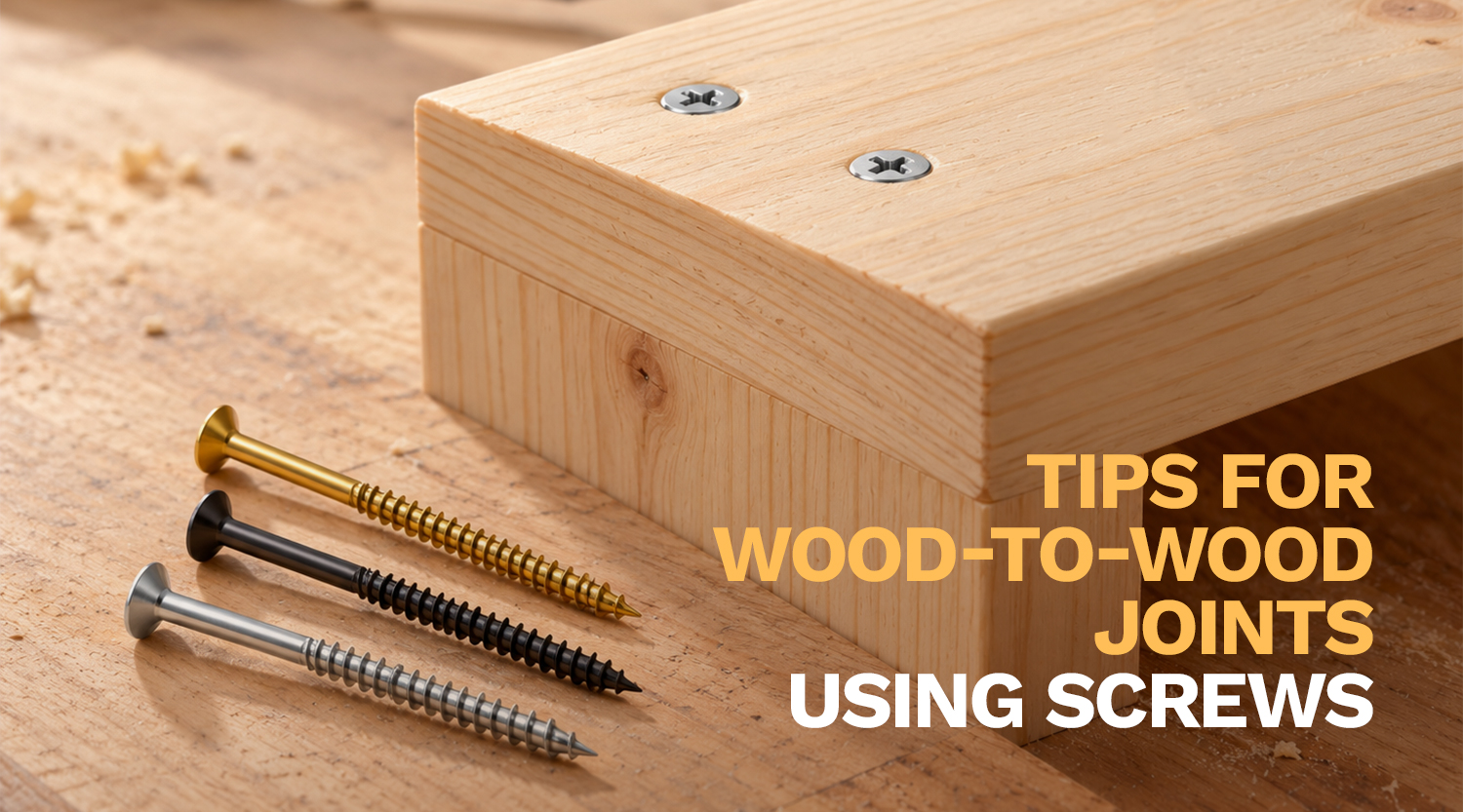
A screwed joint between two boards pulls tight only when the thread grips the lower board alone. Most wood joints using screws that loosen within a year were never fully tight, because the thread was biting the top board as well and holding the pieces a hair apart from the first turn.
When a screw threads into both pieces at once, each board locks onto its own stretch of thread and the top board climbs the screw exactly as fast as the bottom one. The gap never closes. Karigars call it a joint with no pakad, and in dealer returns we see the screw blamed far more often than the drilling.
A clearance hole in the top piece fixes this. It has to be wide enough for the thread to pass through without touching the wood, so the countersunk head has something to push against and every turn pulls the upper board down until the head seats flush.
Pilot holes are different. A pilot hole goes into the bottom piece only and is narrower than the thread. Without it, teak, sal and other dense hardwoods split along the grain as the thread forces its way down, and the crack often stays hidden under the head until the joint takes weight. Softwood and the face of 18mm MDF often manage without one. MDF edges are an exception covered below.
A self-thread screw carries a deep, sharp thread that cuts its own mating groove as it goes in, which makes it the furniture screw most board work depends on. Our SS Chipboard is one. The thread is cut deep and sharp so it slices through particleboard and MDF without cracking or splitting the board.
Board has no long grain. A coarse thread has nothing to wedge into, so the screw holds only by the material trapped between its threads, and a shallow thread in a modular kitchen carcass gives up once doors start swinging on it every day.
Screw into the face of MDF and most threads hold for a while. The edge is harder. A coarse thread there bulges or splits the core, while the sharper thread of a chipboard screw cuts a cleaner path between the layers.
A conventional wood screw suits solid timber, where the grain gives the thread real fibre to bite and a pilot hole keeps hard species like teak or sheesham from splitting. Our Wood Phillips and CSK Wood are made for it. Both run from gauge 4 to 16 in lengths of 12mm to 150mm.
Board takes SS Chipboard. If the lower piece is solid timber, the choice narrows to Wood Phillips or CSK Wood, and the drive settles which one.
Wood Phillips has a Phillips recess and is the machine driven version, built for a drill. CSK Wood has a single slot for a hand screwdriver, and a drill bit on a slot tends to cam out and chew the head. On a site with power and a few hundred joints to make, Wood Phillips saves real time. Old furniture repairs still go better by hand, since a slotted CSK Wood matches the slotted heads already in the piece.
Stainless steel goes near water. In an Indian kitchen or bathroom that covers most joints below the counter, and monsoon humidity gets inside homes in coastal cities too, so a wardrobe in Mumbai sits closer to a wet location than it looks. MS suits dry indoor work. CSK Wood comes in SS only, while Wood Phillips is available in both SS and MS.
As a wood screw manufacturer, we make Wood Phillips for drill work and CSK Wood for hand driving in the same sizes, so a dealer can match a joint by drive alone. Both come in Silver, Gold and Antique finishes, packed 100 screws to a pouch at a plant that is CE Certified, ISO 9001-2009 certified and follows DIN 7982.
A split along the grain means the pilot hole was missing or too small. End distance matters too. A screw that spins without tightening has stripped the thread it cut in the wood, and in softwood and board that usually traces back to a drill clutch set too high. The usual repair is a fresh hole a little to one side of the stripped one.
Screwing into end grain runs the thread parallel to the fibres, and it holds far less than the same screw driven across the grain. A longer screw buys some of that back. Glue with the screws acting as clamps holds better than screws alone, which is how most butt-jointed shelf frames should be made.
| Joint | LP product | Drive | Size range |
| Solid timber, drill | Wood Phillips | Phillips | Gauge 4 to 16, 12mm to 150mm |
| Solid timber, by hand | CSK Wood | Single slot | Gauge 4 to 16, 12mm to 150mm |
| MDF and particleboard | SS Chipboard | Phillips | M3.0 to M5.0, 12mm to 100mm |
| Outdoor bench or deck board to frame | Carriage Bolt | Nut from below | 6mm or 8mm, 38mm to 250mm |
A wardrobe needs two screw types. Wood Phillips goes into the solid wood frame and SS Chipboard into the board carcass, and a mistri carrying one box of one furniture screw ends up forcing the wrong thread into half the joints.
The Carriage Bolt takes over when a wood-to-wood joint carries load outdoors. Its square neck bites into the wood as the nut tightens from below, and the smooth dome head leaves nothing on the surface to catch a hand.
Before the next joint goes in, check the top board for a clearance hole. In our experience that step fixes more loose furniture than any change of screw, and the product pages linked above list every gauge and length for matching one to the timber in hand.
1. Wood screw vs. self-thread screw, which one holds in MDF?
The self-thread screw. Its deep, sharp thread cuts into MDF without splitting the board, while a conventional wood screw is better suited to solid timber with a pilot hole.
2. How to choose the right wood screws for a kitchen cabinet?
Pick stainless steel for anything near water, then choose by the lower piece and the drive. SS Chipboard suits board carcasses, and Wood Phillips or CSK Wood suits solid timber frames.
3. Does the wood screw manufacturer matter for furniture joints?
Yes, because thread depth and finish vary between makers. LP Screw is CE Certified, ISO 9001-2009 certified and follows DIN 7982, and offers a 5-year rust and moisture resistance guarantee.


