
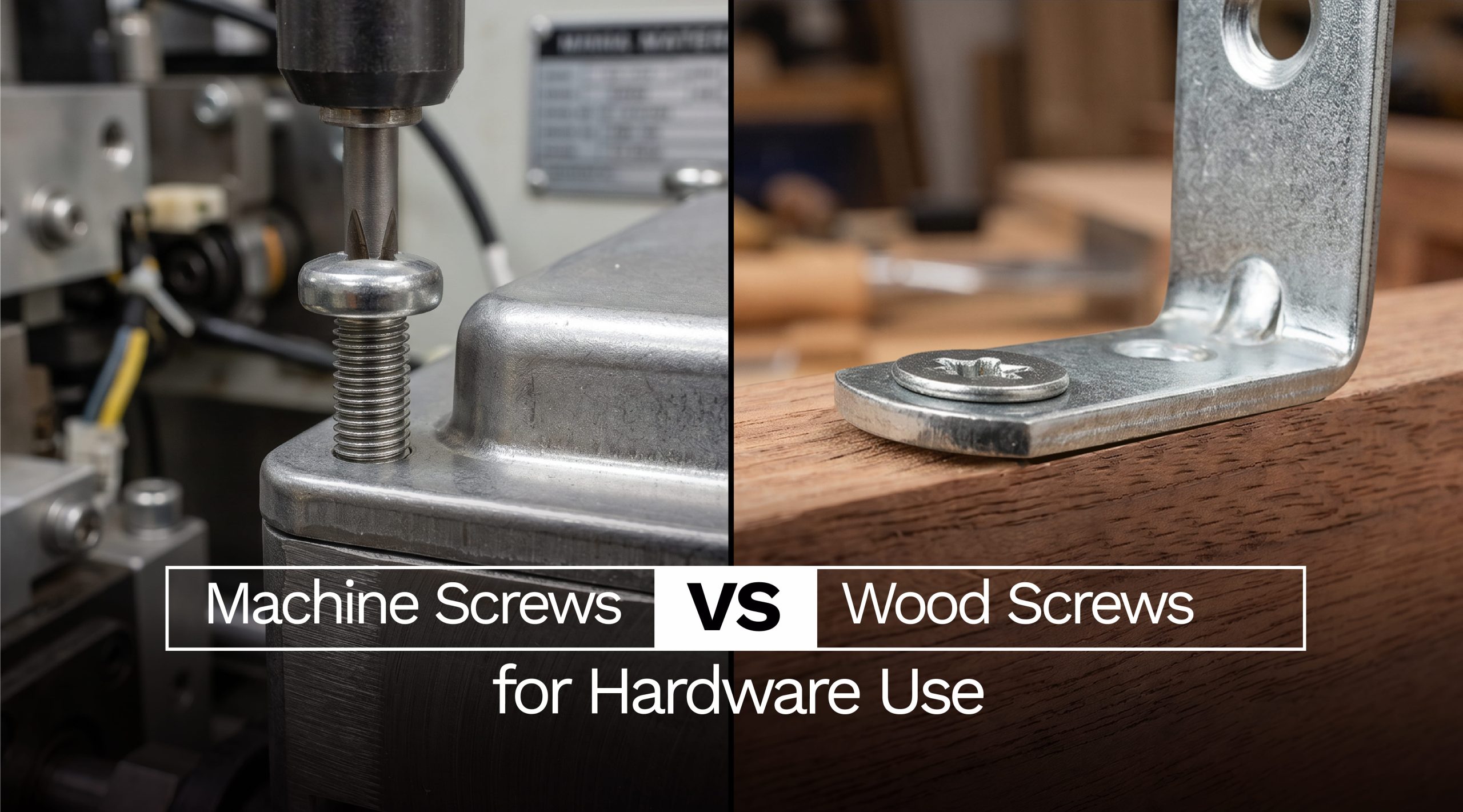
On a busy site, screws get grabbed from whatever packet is closest. Be it the wood screw, machine screw, be it the same size or similar head or both Phillips drive. The difference is not obvious until you are looking at a fitting that will not stay tight no matter how many times you tighten it.
On a modular kitchen job, both screws end up in your hand at different points of the same day. The carcass assembly needs one. The hinge plates need the other. Mixing them up does not always look wrong in the moment. It just performs wrong over time.
The thread is not just a design detail. It is the function. A wood screw has a coarse, widely spaced thread with a sharp tapered point. That geometry exists for one reason: to carve through wood fibre and grip it. The thread cuts its own path. No pre-drilling needed in most softwoods. The holding power comes from how tightly the thread bites into the grain around it.
A machine screw is the opposite in almost every way. Fine, consistent thread from end to end. Uniform shaft diameter. Blunt tip. It does not cut into anything. It needs something to receive it, a nut on the other side, a pre-tapped hole, or a hardware fitting with a hole sized to match.
That one distinction settles most of the confusion around which screw goes where.
Wood screws are built for wood-to-wood joints. Carcass assembly. Shelf cleats. Cabinet frames. Timber to timber, or screw into ply or MDF where the thread has wood fibre all around it to grip.
In these situations a good wood screw from quality wood screw manufacturers holds exceptionally well. The coarse thread bites deep, seats fast, and does not need a pre-drilled hole in softer material. For structural furniture joints, the kind that carry load quietly for years and this is exactly the right tool. For materials such as sheesham, pine, plywood or even the MDF, each works with a wood screw in a different manner. Sheesham and other hardwoods need a pilot hole first or the screw will not drive straight. In softer ply and MDF, the coarse thread seats on its own. Knowing the material saves time and prevents splits before they happen.
Hinges, drawer channels, tower bolts, wardrobe sliding tracks, handles, all of these are metal hardware with pre-formed holes. When you drive a screw through that hole into the wood behind it, the screw is passing through metal before it reaches wood.
A wood screw does not grip that metal hole. It passes through loosely. All the holding power sits in the wood fibre below. That is fine for a static joint. It is not fine for hardware that moves or opens, closes, slides and swings under load every single day.
A furniture screw in a hardware fitting needs to engage with the fitting itself, not just anchor into the wood behind it. Machine screws do this. Their consistent thread creates a proper mechanical connection with the hardware plate. The joint is tighter, more repeatable, and far more resistant to the directional load that hardware takes over its lifetime.
This is not a small distinction. In modular kitchen work especially, hinge plates and drawer channels are under constant use. The screw choice at fitting stage is what determines whether that hardware stays solid for a decade or starts rocking within months.
Tower bolts take lateral force every time someone slides them. Wardrobe channels carry the full weight of a shutter through hundreds of cycles. Auto hinges open and close under load daily. Each of these fittings transfers force directly through the screw and that force needs a thread designed to handle it, not one designed for wood grain.
Choosing machine screws over wood screws for hardware is the first decision. The second is which stainless steel machine screws type suits the specific fitting. Head geometry changes how the screw interacts with the hardware plate, and getting that wrong creates the same problems as using the wrong screw entirely.
The countersunk head sits flush with or below the surface once driven. Use this for hinges, drawer channels and wardrobe sliding tracks, anywhere the screw head must not protrude above the fitting. LP Screw’s CSK Phillips range covers gauge 3 to gauge 16, which spans the full width of standard Indian hardware fittings.
The pan head sits above the surface. Its wide flat underside distributes clamping pressure across the fitting rather than sinking into it. Use this for sofa leg brackets, castor wheel plates, auto hinges and bed frame fittings and hardware where clamping from above is the correct action.
Both stainless steel machine screw types come in silver, gold and antique black finishes. In visible cabinetry and interior furniture work, that finish choice matters more than most people factor in at the ordering stage.
| Feature | Wood Screw | Machine Screw |
| Thread type | Coarse, widely spaced | Fine, consistent |
| Point | Sharp, self-drilling | Blunt, needs pre-drilled hole |
| Shaft | Tapered | Uniform diameter |
| Best for | Wood-to-wood joints | Hardware fittings on wood |
| Load type handled | Static structural | Repeated directional |
| Finish options | Silver, gold, antique | Silver, gold, antique |
The karigar who has been doing this for twenty years makes this call automatically. He reaches for the chipboard screw when he is building the carcass and switches without thinking when he picks up a hinge plate. That instinct is just experience with machine screws vs wood screws made practical.
For everyone building that experience: wood fibre all around the thread means wood screw. Metal hardware plate in the path means machine screw. And when you are at the hardware shop or placing a bulk order, specifying the right stainless steel machine screws type such as CSK or Pan Phillips, SS or MS is the last step that locks the whole decision in.
Explore LP Screw’s full range of machine screws and wood screws at lpscrew.com/products or reach us at info@lpscrew.com for specifications and bulk enquiries.
1. Can I use wood screws for fitting hinges and drawer channels?
A wood screw passes through the metal plate without gripping it. All holding power sits in the wood alone. For hardware under daily use, a machine screw is the correct choice.
2. What is the difference between CSK and Pan Head machine screws for furniture?
CSK sits flush and you can use it for hinges and channels. Pan head clamps from above, so use it for leg brackets and castor fittings.
3. Which stainless steel machine screw type should I use for modular kitchen hardware?
CSK Phillips for drawer channels, hinges and sliding tracks. Pan Phillips for surface-mounted fittings. Stainless steel holds up against kitchen humidity better than mild steel.


