
This is the frustrating part of getting fasteners wrong. Unlike a broken tile or a misaligned door frame, a bad fastener does not fail on day one. It fails after load, after weather, after vibration. By then, the supplier is long paid and the site has moved on.
A fasteners supplier who skips quality checks knows this. The failure will not come back to them, it will come back to you. That is why the burden of verification sits firmly with the buyer. The questions below are ones every procurement manager and site engineer should ask before placing an order.
Here, everything starts with steel. For stainless steel fasteners, Alloy composition determines how the screw will perform in condktions such as moisture, chemicals and heat. A supplier who sources steel without traceability documents is a risk.
You shall ideally ask for the Material Test Certificate (MTC) for every batch. This document helps in understanding the chemical composition of the steel used such as chromium content, nickel percentage, carbon levels etc. If a supplier of fasteners cannot produce this on request, that tells you something important about how they operate.
Good manufacturers source from certified mills with full batch traceability. That means if a problem surfaces six months in, they can trace it back to the exact coil of steel the screw was made from. Suppliers who buy from the open market without documentation cannot do this.
One more thing: verify whether the steel is primary (fresh production) or re-rolled secondary material. Secondary steel is cheaper. It is also inconsistent in composition and more prone to micro-fractures under stress.
A screw that is 0.2mm off-spec sounds like a small problem. On a production line, that 0.2mm becomes a stripped drive recess on every third screw. On a structural joint, it becomes a thread that never fully engages.
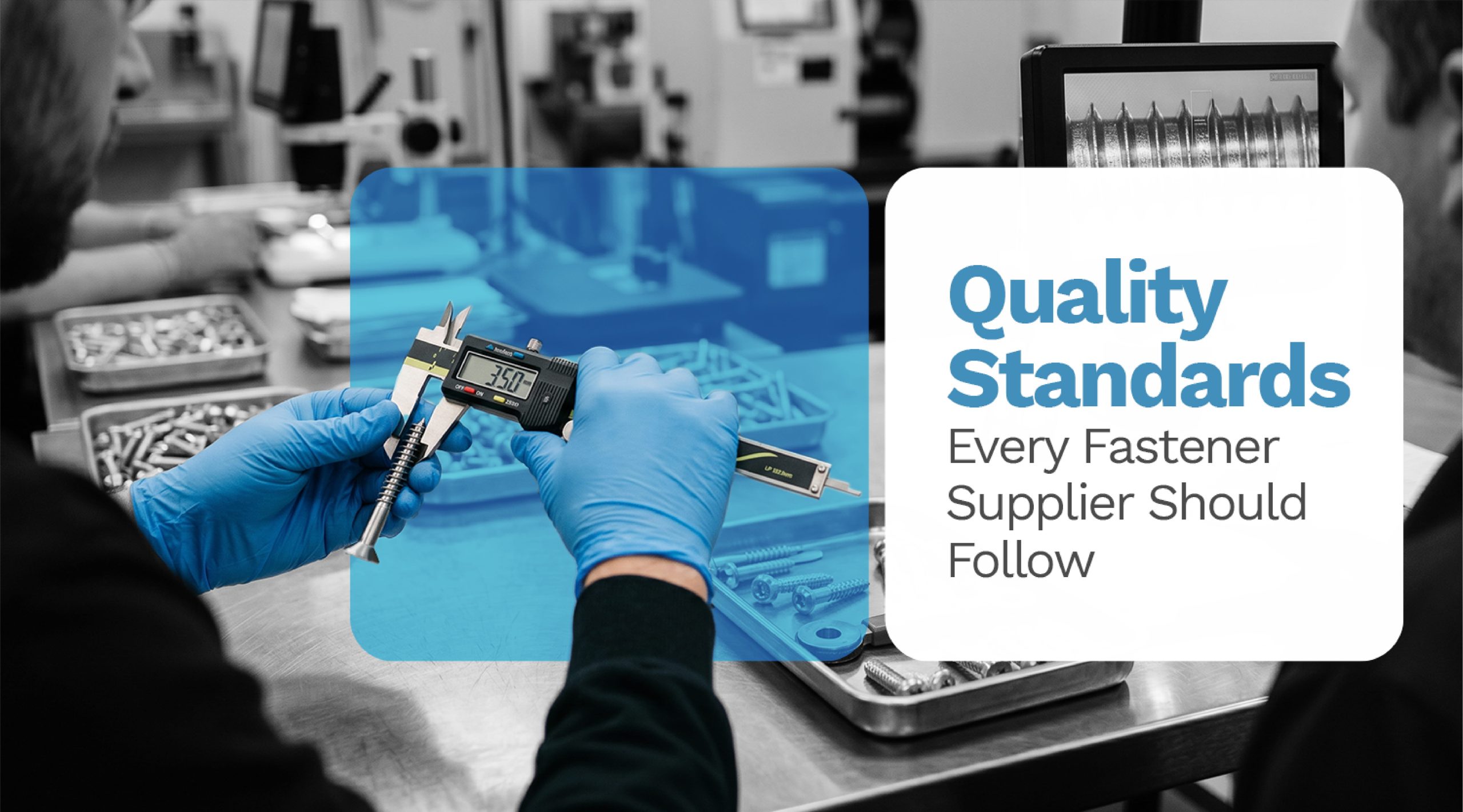
Any serious fasteners supplier runs dimensional checks throughout production, not just at final inspection. The checks that matter most are:
Asking your supplier of fasteners about the dimensional checks is a great way to ensure the consistency in these parameters.
For stainless steel fasteners going into kitchens, coastal buildings, chemical plants or outdoor structures, corrosion resistance is the most important property on the list. And it is the one most easily faked. A good coating looks the same as a poor one on day one. The difference shows up at month six.
To learn more about corrosion resistant screws check out this blog.
The standard way to verify corrosion resistance is the salt spray test. The fastener is placed inside a chamber spraying a 5% sodium chloride solution continuously. The test runs for a set number of hours around 48, 72 or 96. After the test period, the screw should show no signs of red rust on the base metal.
Ask any fasteners supplier what their salt spray hours are. A supplier who clears 96 hours is meeting a serious benchmark. One who cannot answer the question at all is telling you that this test is not part of their process.
LP Screw’s SDS fasteners, for example, carry a CR6+ coating at 6 microns thickness and are tested to 96 hours salt spray, nearly double what cheaper alternatives in the market can demonstrate. That is a verifiable number. That is the kind of claim to look for.
Coating thickness is measured in microns. Too thin and the coating offers no meaningful protection. Too thick and it changes the dimensional tolerances of the screw, causing fit issues. Reputable suppliers check coating thickness using a calibrated magnetic gauge on every production batch.
Certifications matter. But not all certificates carry equal weight.
| Certification | What It Verifies | What to Watch For |
| ISO 9001 | Quality management system is in place | Check the certificate is current and from an accredited body |
| CE Marking | Product meets European safety standards | Relevant if fasteners are for export or used in certified installations |
| DIN Standards | Dimensional and mechanical specs meet German engineering norms | Most relevant for machine screws and structural applications |
| Salt Spray Test Report | Corrosion resistance under accelerated conditions | Ask for the actual test report, not just a claim |
A certificate on a website is a starting point. The real question is whether the supplier can produce the current, valid version of that certificate on request, along with batch-specific test reports for your order. If they hesitate, that hesitation is data.
LP Screw is CE Certified, DIN 7982 compliant and operates from an ISO 9001-2009 certified plant. Every claim here has documentation behind it.
Run through this short list before approving any new supplier of fasteners:
If a supplier clears all five, you are dealing with a professional operation. If they stall on two or more, the brochure does not matter.
Fasteners are small. The consequences of getting them wrong are not. The best stainless steel fasteners suppliers in India know this, and they prove it with documentation, not just promises.
Explore LP Screw’s complete range of stainless steel fasteners at lpscrew.com/products or reach us at info@lpscrew.com and +91 90330 04689 for batch specifications and bulk enquiries.
1. What quality checks should I ask a fasteners supplier for before ordering?
Ask for the Material Test Certificate, dimensional inspection report, and salt spray test results. If they cannot produce these for your specific batch, do not order.
2. How do I know if stainless steel fasteners are genuine grade?
Request the Material Test Certificate. It shows the exact steel composition. No MTC means you have no way to verify what you are actually buying.
3. What is a salt spray test and why does it matter for fasteners?
It exposes fasteners to salt mist for 48 to 96 hours to check how long the coating holds before rust appears. Ask for the hours cleared in writing.


