
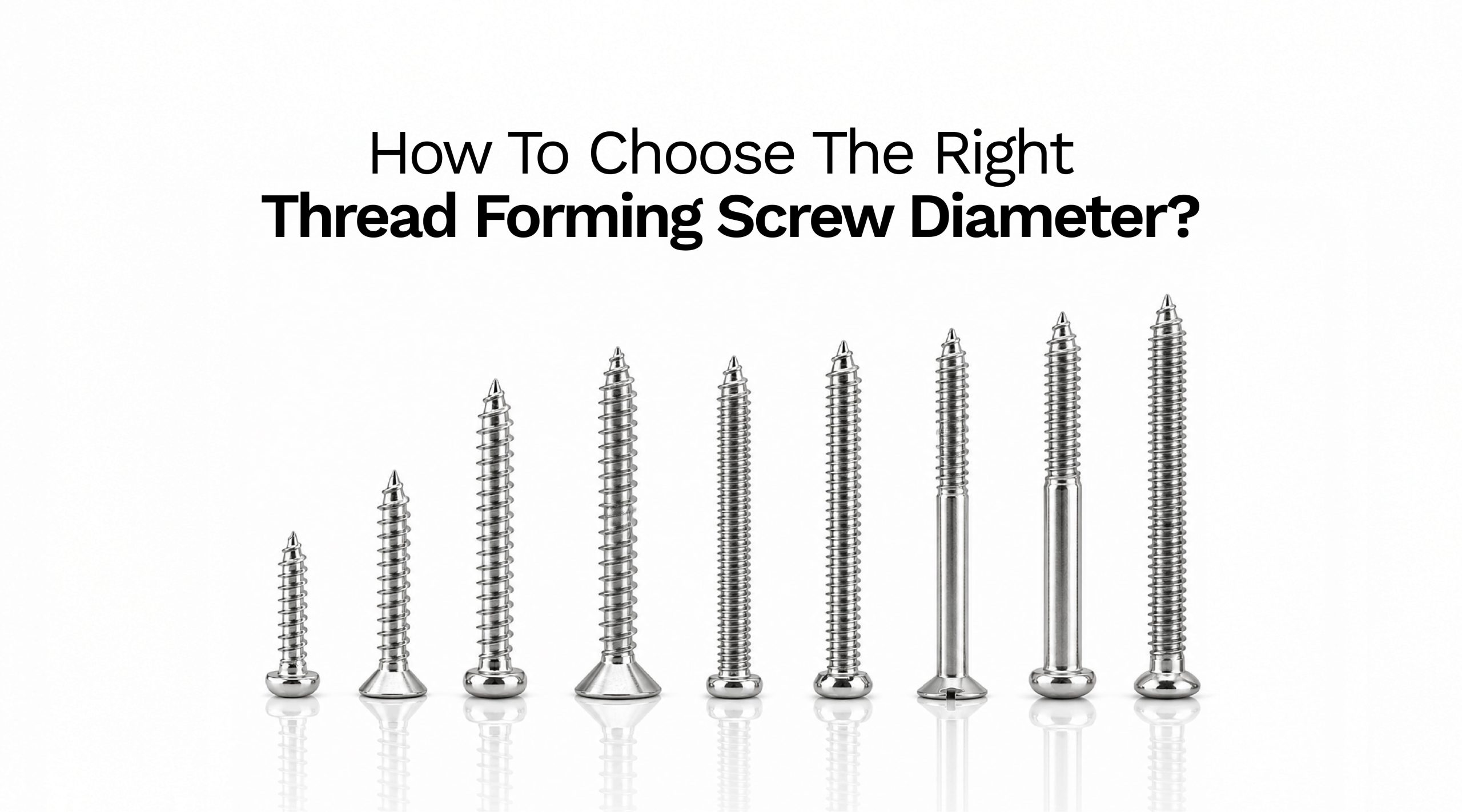
How to Choose the Right Thread Forming Screw Diameter for Your Load
Most people choose a screw diameter by habit. Whatever was used last time, or whatever is sitting closest on the shelf, goes in. With thread forming screws, that habit catches up with you faster than with most other types, because the diameter is not just a sizing detail here. It decides whether the screw actually holds the load or just sits in the hole looking like it does. Get it wrong and you will not always notice immediately. You will notice later, when the joint under load starts to work loose.
What Makes Thread Forming Screws Different
This type of screw does not cut material away to create its thread. It pushes material aside as it is driven in, and that displaced material flows back around the screw shank to form the mating thread. No metal or plastic is removed in the process.
Thread Forming Screws vs Thread Cutting Screws
A thread cutting screw uses flutes to shear away material as it goes, so any excess simply gets removed and a slightly oversized screw still finds its way through. There is no such escape route here. Whatever the shank displaces has to go somewhere within the hole itself, which is exactly why the hole size and screw diameter need to match closely, or the result is stress in the material rather than a proper thread.
Screw Diameter Selection: What Actually Drives the Decision
Screw diameter selection should come from three real inputs, not a size chart picked out of memory. The first is the load the joint needs to carry. A shelf bracket and a structural frame are not asking the same thing of the screw. The second is the thickness and hardness of the material being driven into, since softer materials tolerate a wider diameter range than harder ones. The third is hole tolerance, the pre-drilled hole size the screw is actually going into, since thread forming depends on a specific amount of interference between the screw and the hole.
Skip any one of these three and the diameter choice becomes a guess. It might work. It might not. And with this type of screw specifically, you often will not know which until the joint is under real load, not just hand-tight.
Screw manufacturers in India do not always list hole tolerance clearly on the pack, which is one more reason to confirm it yourself before ordering in bulk rather than assuming it matches your drawing.
What Happens When the Diameter Is Wrong
An undersized screw is the more deceptive failure of the two, since it can feel driven in properly and still fail later. An oversized screw usually announces itself immediately, through the torque needed or visible stress in the material around the hole.
This shows up often in small fabrication units, where a batch gets driven at speed without a test piece. A supervisor moving fast through a site will not always stop to check torque on every screw. That is exactly the kind of shortcut where an undersized diameter goes unnoticed until the monsoon season, when a joint that felt fine in April turns loose by August.
Getting the diameter wrong in either direction causes a different failure, and both are common on site.
| Diameter Choice | What You Will See |
| Too small | Weak thread engagement, the screw turns easily but grips poorly, joint loosens under load |
| Correct | Smooth, even resistance while driving, thread forms cleanly, joint holds steady |
| Too large | High driving torque, cracked or stressed material, risk of the screw seizing partway in |
An undersized screw is the more deceptive failure of the two, since it can feel driven in properly and still fail later. An oversized screw usually announces itself immediately, through the torque needed or visible stress in the material around the hole.
Where Thread Forming Fits Across Screw Applications
Thread forming shows up across a wide range of jobs, but not every screw in a range works the same way. It helps to compare against what does not use this method. LP Screw’s Machine Screw range, for instance, is designed to go into a pre-tapped hole or work with a nut. The thread is already cut before the screw ever goes in, so there is no forming happening at the point of installation.
Our SDS range works differently. It is built to drill its own hole and cut its own thread into metal in a single action, without a pre-drilled hole at all. That is a related but distinct mechanism, and it is why diameter and drill capacity matter just as much there. Our SDS screws are rated to drill through 4mm to 4.5mm thick metal, made from Carbon Steel, which only holds true when the screw diameter is matched correctly to that thickness in the first place. Choose too small a diameter for the metal you are working with and that rated capacity means nothing in practice.
A Quick Way to Check You’ve Got the Diameter Right
Before committing to a full run of screws for a job, drive one test screw into a sample of the actual material you will be using, not a similar one. Feel the resistance as it goes in. It should build smoothly and evenly, not suddenly, and not stay suspiciously light the whole way. Back it out and check the hole. Clean, even thread marks mean the diameter is right. A loose, torn, or shiny smeared thread means it is not, and it is worth adjusting before the job, not after.
Diameter is not a detail you can eyeball with this type of screw the way you sometimes can with other types. It is a calculation based on load, material, and hole size, and skipping that calculation is usually where a joint that looked fine on day one starts failing by month three. If you are unsure which diameter fits your specific application, it is worth checking the manufacturer’s size range against your material thickness before you order in bulk.
Frequently Asked Questions
1. What is the difference between thread forming and thread cutting screws?
One displaces material to create a thread, the other removes it with flutes. Forming suits softer materials and controlled holes, cutting suits harder ones needing material clearance.
2. How do I know if my screw diameter is too small?
The screw turns with little resistance and the joint feels loose under load, even though it looked driven in properly. Weak thread engagement is the main sign of an undersized diameter.
3. Does material thickness affect screw diameter choice?
Yes. Thicker or harder material needs a diameter matched closely to the pre-drilled hole, since there is less room for the material to safely displace during thread formation.


